PETER VAN ZANDT LANE

Music + Coastal Ecology
Composition & Music Tech with the GCE-LTER
In 2024, I began a piece for orchestra and electronics, Coastal Portrait: Cycles and Thresholds that incorporates sonified data from scientists associated with the Georgia Coastal Ecosystems Long-Term Ecological Research domain. Coastal Portrait was initially supported via a Georgia Sea Grant Artists, Writers, and Scholars grant, but has opened up a line of environmentally-engaged creative activity that has continued into other projects. This page is intended to share that work with some extra depth and context.
Page Contents (click to jump down):
1. Coastal Portrait: Cycles and Thresholds
2. About the Georgia Coastal Ecosystems LTER
3. Data-Driven Spatial Heterophony
4. Translating Coastal Ecology into Music for Orchestra and Electronics
Coastal Portrait: Cycles and Threholds
This recording is a live performance by Boston-based multi-Grammy nominated string orchestra, A Far Cry, at the 2025 International Computer Music Conference in MIT's newly constructed Thomas Tull Concert Hall.
Some context from the program notes:
...a dialogue between intuitively composed orchestra music and data-driven electronic sound.
...8 speakers surrounding the audience corresponds to eight of the research sites...the aggregate sound highlights the cyclical patterns of fresh water and salt water exchange...
Coastal Portrait: Cycles and Thresholds is a work for orchestra and electronics, featuring spatialized electronic sounds derived from the sonification of environmental data gathered by scientists associated with the Georgia Coastal Ecosystems Long-Term Ecological Research Project. Throughout the piece, there is a dialogue between intuitively composed orchestra music and data-driven electronic sound: synthesized sonic translations of tens of thousands of data points measuring temperature and salinity of waterways, marsh vegetation data, and data (both recorded and projected) relating to sea level rise on the Georgia coast. Conceived in conversations between composer Peter Van Zandt Lane and Marine Scientist Dr. Amanda Spivak, the piece unfolds through musical explorations of the GCE Project’s central focus: long-term patterns of ecological change in Georgia’s coastal estuaries and wetlands. In mapping data collected by dozens of scientists across decades to electronic sounds, a portrait of coastal environments –their natural cycles, how they are responding to global change, and insight into how they may fare in the future– is woven into the musical tapestry. In a sense, the electronics serve as the objective observer, while the orchestra may be heard as a the human interpreter; we hear cycles in the strings echoing the cyclical characteristics of the data (largely repetition with variation), but also moments where thresholds are crossed: a rumination on the points where cyclical ecological patterns give way to unrecoverable change (e.g. the alarming data related to sea level rise).
The use of 8 speakers surrounding the audience corresponds to eight of the research sites throughout the Georgia Coastal Ecosystems Long Term Ecological Research domain. Many of the sounds feature synchronized data representing distinct geographical locations. While hearing all 8 data streams can be somewhat chaotic, the aggregate sound highlights the cyclical patterns of fresh water and salt water exchange and local temperatures (while also making outliers more noticeable). Gliding sounds represent average plant heights each year at each site, creating chords that transfer between the orchestra and electronic sounds. The resolution of the piece immerses us in the environments themselves, featuring soundfield recordings sources by the composer near GCE-LTER ecological research sites. This composition (and the associated audio installation, Coastal Cycles II), was supported by a Sea Grant Artists, Writers and Scholars grant from the National Oceanic and Atmospheric Administration under the United States Department of Commerce.
Many thanks to data shared by GCE scientists: Amanda Spivak, Daniela Di Iorio, Merryl Alber, and Steven Pennings, and all of their teams of graduate students and research associates, whose funding comes from the National Science Foundation. Sonification was also made possible by data instrument programming by Jared Tubbs.
About the GCE-LTER
That program note's a lot to chew on, even by contemporary music standards. So what exactly is Georgia Coastal Ecosystems Long-Term Ecological Research?
The Georgia Coastal Ecosystems Long Term Ecological Research site (GCE) was established by the National Science Foundation in 2000. The study domain encompasses three adjacent sounds (Altamaha, Doboy, Sapelo) on the coast of Georgia, U.S.A., and includes upland (mainland, barrier islands, marsh hammocks), intertidal (fresh, brackish and salt marsh) and submerged (river, estuary, continental shelf) habitats.
GCE LTER researchers seek to understand how these ecosystems function, how they change over time, and how they might be affected by future changes in climate and human activities.

"Data-Driven Spatial Heterophony"
Say that ten times fast!
This where I get to pontificate on data sonification, which I will try to do as concisely and non-dogmatically as possible (despite positing that the term "data-driven spatial heterophony" is not at all ironic, if slightly pretentious sounding.)
I won't dive too deep into the debate of what is or isn't a legitimate process for translating scientific data into sound. There's no shortage of opinions, ranging from broadening the definition of what data sonification is to nearly all-encompassing proportions, or to Tantacrul's nearly dismissing it altogether (amid a good number of totally fair critiques). It might be helpful to distinguish between data sonification and data-driven sound, the former being sound synthesized with the intention to communicate explicit data, while the latter is more loosely intended to create a sonic artifact that has an intertextual relationship with a data set, which might be used in more artistic contexts like concert music or audio installations.
The electronic sounds created for Coastal Portrait do adhere to Thomas Hermann's guidelines on data sonification, and could be an aid to communicating data if isolated and contextualized. But the project for this piece was not just to create sonic artifacts that would aid in communicating data. It was to compose a piece for orchestra and electronics that incorporate sonified data from the GCE-LTER. Because of this, I prefer to describe the electronic components of these projects as data-driven sound, despite going through the whole process with the idea that any of the scientists should be able to utilize my audio as legitimate data sonification if they were so inclined.
A critical aspect of the data-driven sounds comes from the capacity of sonified data to preserve aspects of the phenomena the data represent. The most ubiquitous of these in data sonification is time. Data visualization in static form tends to translate temporality into spatial parameters (e.g. on the x-axis of a graph). We're very used to reading time as left-to-right on a printed graph. Proponents of data sonification often point to the ability to maintain temporality in a temporal medium (even if the scale changes drastically). All of my sounds in Coastal Portrait depend on data collected continuously over time, at varying scales: 50 years worth of monthly peak temperatures measured on Sapelo Island, annual measurements of marsh grass height, data on sea-level rise, or daily measurements of temperature and salinity from multiple different locations on the Georgia coast.
It's that last one that got me excited about the possibilities of really leveraging multi-channel audio for this project. You see, experiencing time as time is almost always a given for sonified data. But data that has a spatial element opens up a unique opportunity to translate multiple threads of synchronized data into different speakers at the same time. Spatial preservation in the sonification process was a unique opportunity of the GCE-LTER data sets. Much of the same data is being collected concurrently on a daily basis across the many sites of the GCE-LTER domain, I simply needed to find a way to feed tens-of-thousands of data points from 8 different research locations into 8 different speakers at the same time.
With the indispensable help of Jared Tubbs, we created a Max patch that could read directly from eight of the site-specific data sets while synchronizing the date of measurement, then synthesize out eight channels concurrently. In the example below: temperature corresponds to pitch; salinity to amplitude and probability of articulation.
Actually, an enormous amount of the electronic sounds in Coastal Portrait: Cycles and Thresholds draws from salinity and temperature measurements. It seems simple and not very dramatic, but in my conversations with scientists I increasingly grew to appreciate how the simple question of "how much salt is in the water here?" is one of enormous consequence. In Richard Powers' novel, Playground (required reading!), he sums it up more succinctly than I ever could: "The great ocean engine ran the world and decided the fate of all life. Most of humanity had no idea how beholden they were to the interplay of salinity and temperature."
The example above has been folded down from 8-channel surround to stereo, but you get a sense of how much activity is going on with the patch –a custom-built synthesizer that "performs" tens-of-thousands of data points from eight different research sites– outputting temperature and salinity measurements all at once. But when you can experience the sound fully spatialized, you begin to hear the aggregate patterns: the overall pitch swells up and down with seasonality, activity level is denser towards the front of the space (outputting data from GCE sites 8 and 10, with other sites positioned around you as if your are in the middle of the sites, facing the coast). Salinity patterns drive an increase in sonic activity sweeping over the listener: a result of patterns in sea level change (cyclical or linear).
"The great ocean engine ran the world and decided the fate of all life. Most of humanity had no idea how beholden they were to the interplay of salinity and temperature."
- Richard Powers, Playground

Ultimately, I hear this process of complex data, following some general synchronized patterns of seasonality, climate, and tidal flow, as a kind of texture-oriented heterophony. Heterophony is defined as multiple instruments performing the same basic melody simultaneously, but with each playing with individual variation. Mapping spatial aspects of a multi-site research project helps capture the immensity of the GCE-LTER project, and provides a meaningful way to sonically experience large scale patterns in temperature and salinity over time, and across geographic space. Much of the electronic sounds are drawn from these data-driven heterophonic samples, with one instance that is pitched (highlighting temperature) and un-pitched (highlighting salinity (via conductivity) measurements. It was important to me that I not "fudge" the data to get a particular sonic effect. But since the aim of the actual composition was to write a piece of music that incorporated data as a major component –less for the purpose of explicit dissemination of interpreted data but for the implicit process of framing scientific data as a cultural artifact– I took the license to slow-down and speed-up these sounds for purely musical reasons, while always keeping all channels temporally and spatially synchronized, driven only by GCE-LTER data, and scaling data mapping parameters (aside from time) consistently throughout the piece.
Not all of the data-driven synthesis used in Coastal Portrait deals with such large data sets. I mapped annual plant height measurements across three octaves of range (salinity and water level impacts many aspects of biodiversity including height of this specific species of marsh grass). The resulting variance in plant height data creates chords. These appear in the second section of the piece (around 7:32 mark of the A Far Cry recording at the top of this page). The electronics gliss upwards, "growing" the multi-site-grass-chord, the strings pick up the chord and gliss back to the bottom: a musical "acting out" of the cyclical plant growth and die-back cycle.
Translating Coastal Ecology into Music for Orchestra and Electronics
Outside of this instance of plant height cycles, most of the sonified data is relegated to the electronic sounds in the piece. I decided to compose this piece around sonified data, but through a process or writing music for orchestra that is not completely alien to how I would otherwise compose a piece for orchestra. I wanted to leverage my intuitive compositional process in a contemporary style of music I felt could engage (and leave space for) electronic data-driven sound, while still capturing my personal experience of the coast and its ecological complexity, fragility, and majesty. My aim is always to write, as I once heard the composer and great musical thinker of our time George Lewis put it, music that is "not an intellectual experience, nor an emotional experience, but a complete experience."
I wanted to communicate some urgency related to our collective impact on coastal ecology, without necessarily hitting the listener over the head with it. I also wanted to write patient, flowing music that evokes the coast the various cycles that can be observed there, both with our senses and with advanced scientific inquiry. For these reasons, the first two major sections of the piece are generally slow and flowing, building tension towards a more rhythmic and intense third movement, which features pointillistic string writing amid electronic sounds driven by monthly peak temperatures on Sapelo Island from the late 1950s to 2020.
As I was nearing the end of writing the piece, I struggled to find an satisfying conclusion. Two things happened that remedied this. One, I was given a data set that covered recent sea level rise with projections into the coming decades. I wasn't initially sure how I could feasibly utilize this data, but ultimately incorporated it into a big, dramatic restatement of a chorale theme in the piece, playing alongside all of the data-driven sounds used in the piece, then using the sea-level rise measurements and projections to drive a low-pass filter that sweeps across the electronics. The effect is a mass of electronic sound disappearing underwater.
The other development was an invitation to curate an audio installation that would be exhibited alongside the works of visual artists associated with the Georgia Sea Grant Artists, Writers and Scholars program at a museum in Savannah. This project (which I'll dig into below) involved field recordings of coastal environments, and I decided to end the piece –which for its first twelve minutes uses only synthesized electronic sounds alongside the orchestra– with soundfield recordings of the coast, fading from the ocean to the wetlands and to the woodlands: following the path of saltwater in both natural cycles, and also as we inevitably cross the threshold of ocean water rising and irreversibly transforming coastal environments as the result of sea-level rise.
This project began in a conversation between myself and Dr. Amanda Spivak, who was an amazingly supportive resource and collaborator. Any artists who are interested in collaborating with scientists would be so lucky to have someone who believes that science-inspired-art is a worthwhile endeavor. The initial support from the Georgia Sea Grant Artists, Writers, and Scholars program got this program off the ground. Building the sonfication systems would have been impossible without the Max-patching and coding skills of Jared Tubbs. Coastal Portrait: Cycles and Thresholds was premiered by the Georgia Tech Symphony Orchestra, and I am deeply grateful to conductor Dr. Chaowen Ting for committing to premiere the work. UGA Student performers in the Contemporary Chamber Ensemble recorded the work, which is included on the album Axils released on Neuma Recordings. Thanks to the players of A Far Cry, as well as Eran Egozy and the other organizers of the 2025 International Computer Music Conference's concert program Future Sounds at MIT.
Coastal Portrait II:
A multichannel audio installation
During the time I was composing Coastal Portrait: Cycles and Thresholds for orchestra and electronics, I was invited to create an audio installation that would accompany an art exhibit of other artworks created with support from the Georgia Sea Grant Artists, Writers and Scholars program. The exhibit, Waves of Wonder, was hosted by the Ships of the Sea Maritime Museum in Savannah, Georgia.
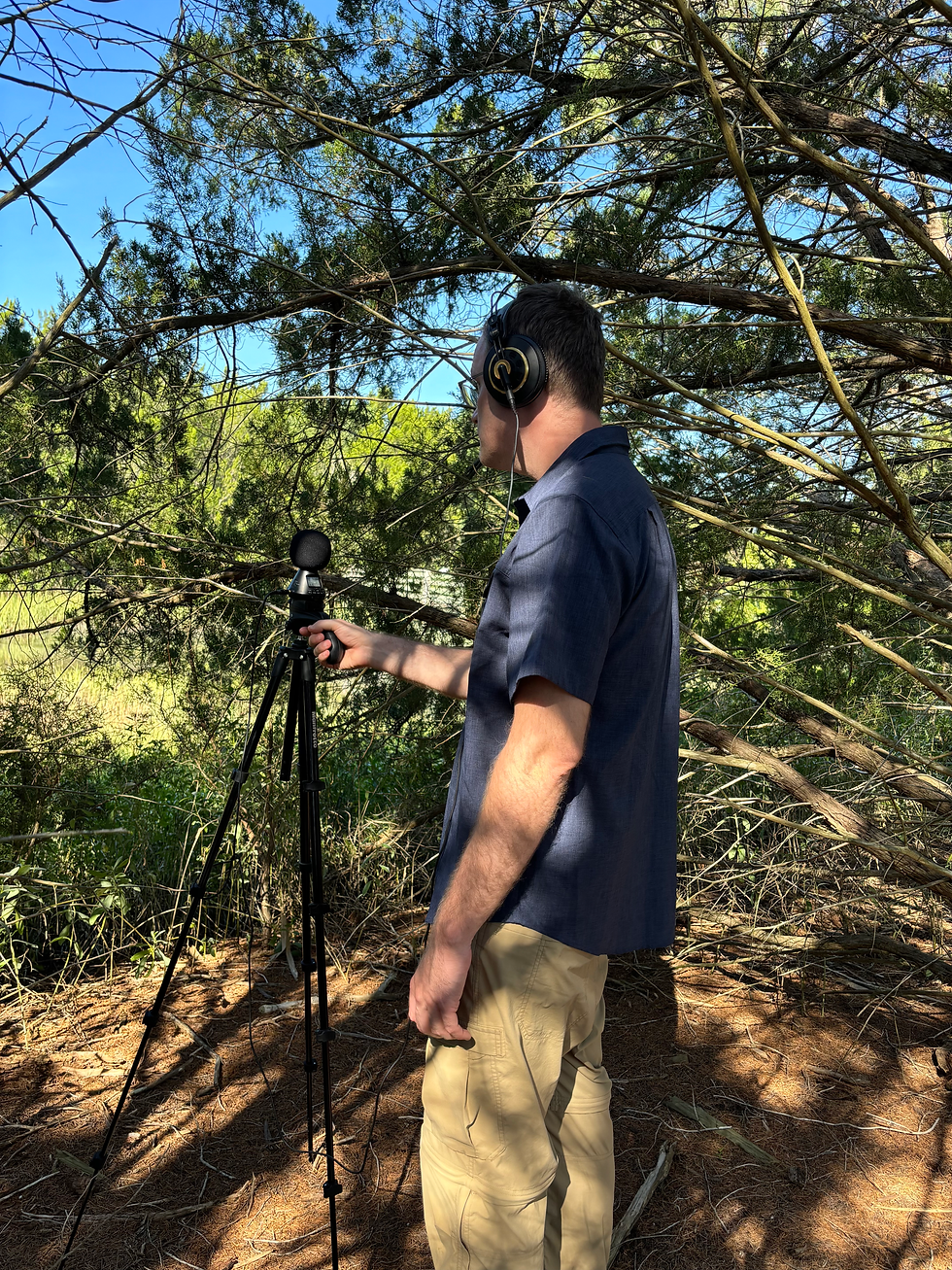
I wanted to feature some of the data-driven electronic sounds in the audio installation, featuring the data amid an immersive audio experience rooted more in sonic ecology than in orchestral composition. I recorded samples of various environments in Coastal Georgia using a 3D soundfield recorder, and mixed the environmental sounds in ambisonics alongside the speaker-specific GCE-LTER data sonification. The result is a looping 20-minute immersive soundscape that takes the listener from the coast, through dune environments, wetlands, and woodlands, then back again: following the cyclical path of salinity that is inextricably tied to the carbon cycle. Intermittently, we hear some of the sonified GCE data interjecting among the environmental sounds.


You can find more info on the Waves of Wonder Exibit at this link. The installation ran at the Ships of the Sea Maritime Museum from June - August, 2024 alongside other creative works by Kip Bradley, Autumn Eckman, Julie de Chantal, Alan Harvey, Kurt Knoerl, Barbara Mann, Dana Montlack, Jennifer Nolan, Casey Schachner, and Josh Stutz. The audio installation was also deployed at the Oconee Cultural Arts Foundation in October 2025 alongside metalwork by Barabara Mann.
